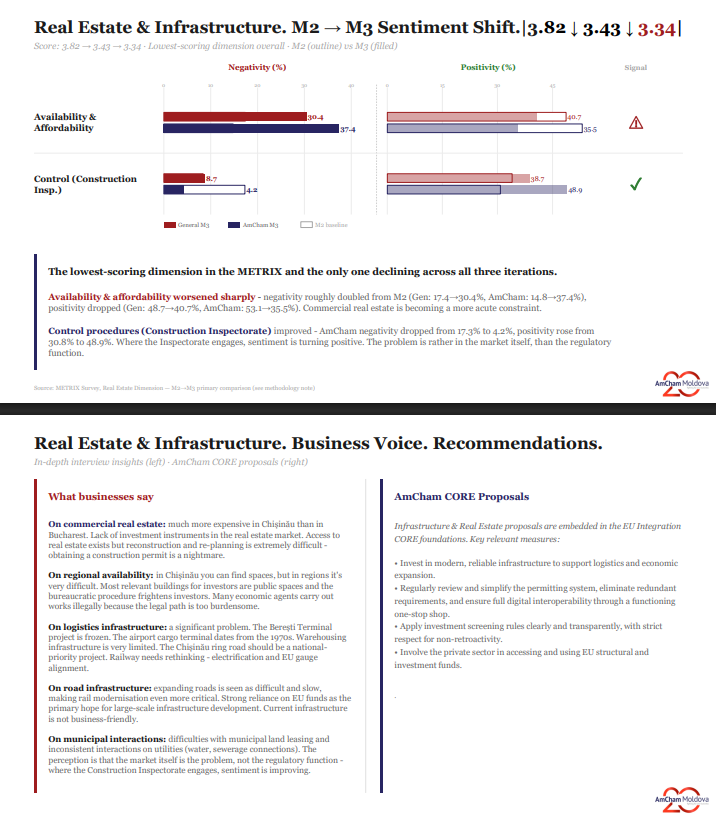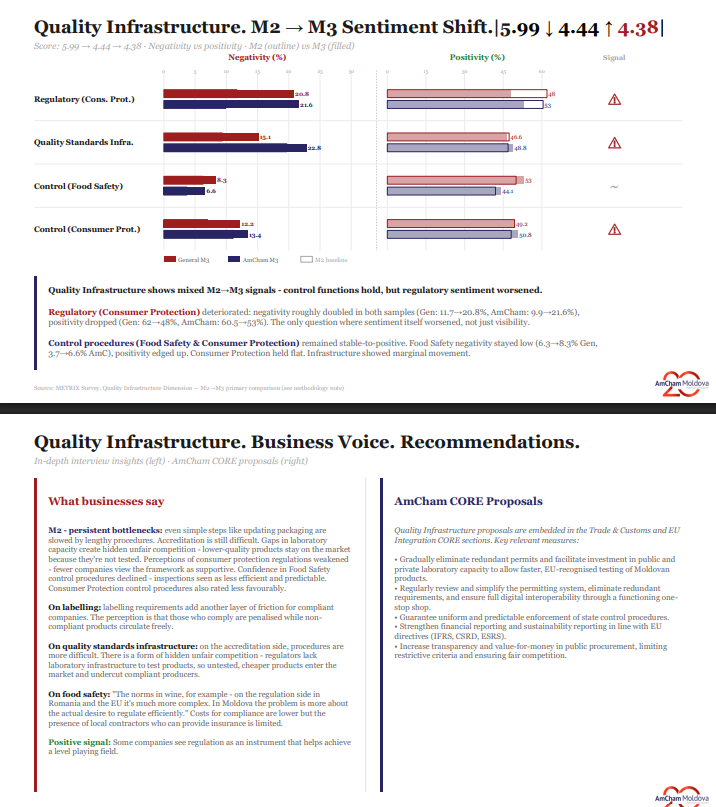
The Third Edition of AmCham METRIX (Moldovan Economic Transformation and Reform IndeX) provides an updated, data-driven assessment of how government policies shape Moldova’s business environment and influence the country’s economic transformation.
METRIX 3.0 brings together business perception, policy impact analysis, and forward-looking regulatory forecasting, offering a structured perspective on Moldova’s competitiveness and reform priorities in the context of the EU integration process.
This edition is grounded in the findings of a nationwide Business Perception Assessment, reflecting how companies experience current policies, regulatory implementation, and the overall predictability of the business climate. It also examines the impact of tax, trade, and labor policy changes on Moldova’s competitiveness, with comparisons to Eastern European EU accession peers.
A dedicated component of METRIX 3.0 focuses on future policy forecasting, including Moldova’s EU accession commitments and the regulatory developments expected to shape the country’s economic trajectory and business environment.
Through METRIX, AmCham Moldova continues to strengthen evidence-based public-private dialogue and support informed policymaking aimed at building a more transparent, predictable, competitive, and resilient economy.
This effort is carried out with the support of Visa, the Embassy of the Netherlands in Chisinau, Victoriabank, with Forbes Moldova as media partner.
The general score of METRIX is:
METRIX is composed of two components:
Component 1 : Business perception assessment
- A survey of a nationwide statistically representative sample of companies evaluating the impact of policies and public administration in 10 critical areas, including taxation, labor, trade, energy, and more. This survey captures both current business sentiment and projections for the next 12 months, providing actionable insights into the state of Moldova’s business climate.
- Future policy forecasting
A forward-looking component that anticipates economic developments in alignment with Moldova’s EU integration goals. This is based on stakeholder consultations with AmCham members, government institutions, and economic researchers, helping to forecast trends and future challenges for the business community.
Component 2 : Policy impact analysis
- A quantitative evaluation of Moldova's fiscal, trade, and labor policies using the Vector Auto-Regression (VAR) model. This model simulates how policy changes influence Moldova’s business environment relative to peer countries, helping benchmark Moldova’s competitiveness in the region
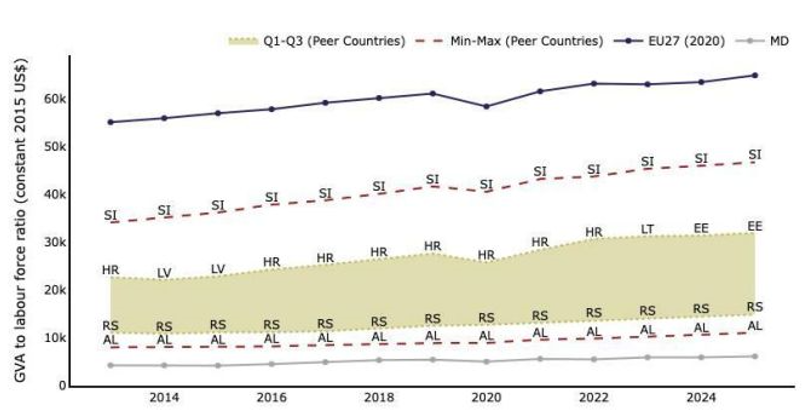
Productivity
Moldova's GVA per worker is roughly one-third of even the lowest peer countries (Albania, Serbia) and one-tenth of the EU27 benchmark.
While productivity has grown in absolute terms since 2014, it has grown at roughly the same pace as lower-ranked peers, meaning the gap is stable rather than narrowing. Understanding why requires looking at the cost and enabling conditions that drive investment.
Peer countries: Albania, Bosnia and Herzegovina, Bulgaria, Croatia, Estonia, Hungary, Latvia, Lithuania, Montenegro, North Macedonia, Romania, Serbia, Slovenia.
Digital
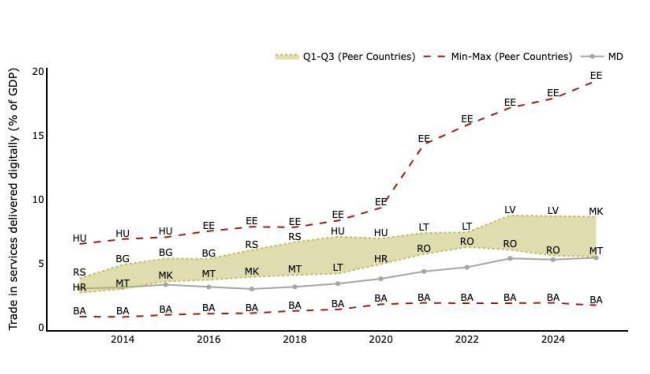
E-commerce as trade in services delivered digitally as % of GDP (positive relationship on productivity): Trade in digitally delivered services has grown from around 3% to 5.5% of GDP since 2014 — a genuine structural shift. Moldova is now approaching the lower end of the peer Q1–Q3 range. Estonia's trajectory (now above 20%) shows the ceiling of ambition for small open economies that successfully pivot to digital exports. Sustaining this growth is the most direct path to productivity catch-up.
Taxes
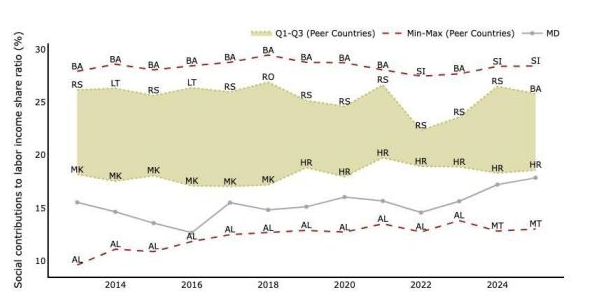
Labour tax as social contribution /labour income share (negative relationship on productivity): Moldova's social contribution burden sits below all peer countries, a structural cost advantage for employers. However, the rising trend since 2020 is worth monitoring: if it continues, it will erode the one area where Moldova clearly outcompetes its peers on cost.
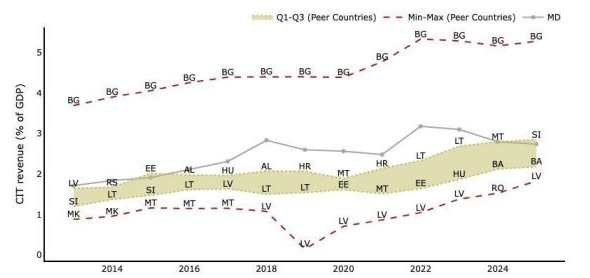
Business tax as CIT revenue as % of GDP (negative relationship on productivity): Corporate tax revenue as a share of GDP has declined and now sits near the peer Q1. This is favourable for business investment. Moldova is not a high-tax environment for firms.
Labour market
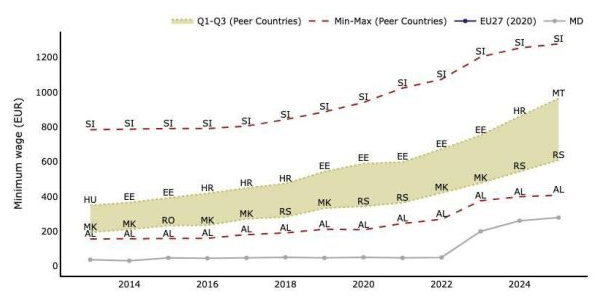
Minimum wage (positive relationship on productivity): Moldova's minimum wage has grown rapidly since 2022 but still below the minimum among peers. This signals improving worker welfare and strengthens domestic demand, which is a positive for productivity growth over the medium term.
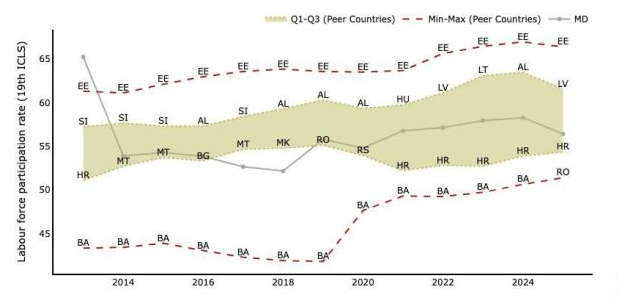
Labour force participation (negative relationship on productivity): 2025 drop of 1.9 percentage points is partly a statistical artefact: the 2024 Census (RPL 2024) revised the resident population downward and a new sampling framework (EMDOS 3) changed weighting. The structural decline is real but smaller than the headline figure suggests, driven primarily by emigration and rising NEET youth.

Key Outcomes of the METRIX Model
- Objective Business Climate Assessment – A structured, quantitative framework to evaluate the effectiveness of economic policies.
- Policy-Driven Decision Making – Enhances public-sector accountability and aligns regulatory policies with business needs.
- Transparency & Predictability – Informs both government and businesses on areas needing reform and improvement.
- Scalability & Regional Replication – The index model can be extended to other policy areas or adopted in neighboring countries.
This initiative positions Moldova for a more competitive, transparent, and inclusive business environment >in alignment with EU integration and global economic best practices.
Stay tuned! METRIX just started.